PicoWay vs. PicoSure: Which Laser Removes Tattoos Better?
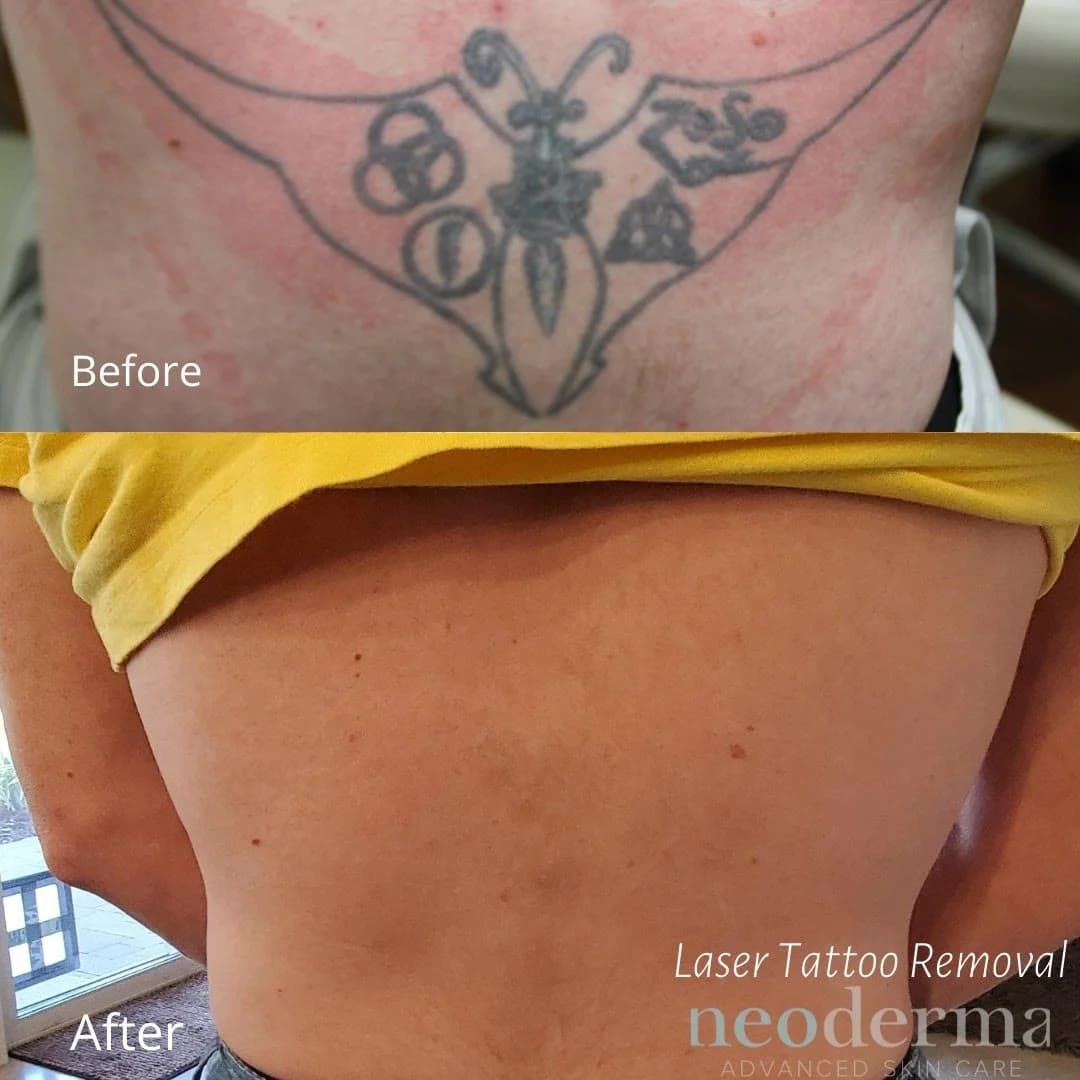
Both are true picosecond lasers — but PicoWay fires three full-power wavelengths(1064, 785 & 532 nm) with shorter pulses and about 2.5× the peak power of PicoSure's single 755 nm beam. That means more ink colors, safer treatment for every skin tone, and typically fewer sessions — which is why Neoderma treats tattoos with PicoWay in Anaheim, from $225 per session.
Medically reviewed by Sal Nadkarni, DO · Last updated July 11, 2026
What do PicoWay and PicoSure have in common?
Both are picosecond lasers — they fire pulses measured in trillionths of a second. Pulses that short shatter tattoo ink photoacoustically: pressure waves crack the pigment into dust-fine particles that your immune system's white blood cells (phagocytes) carry away over the following weeks. That's a generational leap over older Q-switched (nanosecond) lasers, which rely far more on heat, damage more surrounding tissue, and typically need 8–15 sessions instead of 4–8. PicoSure was the first picosecond laser to arrive, in 2013; Candela's PicoWay followed in 2014 and is now used for acne scars and wrinkles as well as ink. If your only choice is between a Q-switched laser and either pico device, choose the pico — but the two systems are not identical.
What's the difference between PicoWay and PicoSure?
Three specs separate them: wavelengths, pulse duration, and peak power.
| PicoWay (Candela) | PicoSure (Cynosure) | |
|---|---|---|
| Native full-power wavelengths | Three — 1064, 785 & 532 nm | One — 755 nm (others via converted handpieces) |
| Pulse duration | ~300–450 picoseconds | ~750 picoseconds |
| Peak power | ~0.9 GW | ~0.36 GW |
| How it breaks ink | Mostly photoacoustic — pressure waves shatter ink with minimal heat | Photoacoustic with a larger thermal contribution |
| Ink colors | Full range — black, red, orange (532), stubborn blues & greens (785), deep black (1064) | Excellent on green & blue (755); other colors depend on handpieces |
| Darker skin tones | 1064 nm is the workhorse for Fitzpatrick IV–VI | 755 nm absorbs more melanin — requires extra caution |
| At Neoderma | ✓ Our system, from $225/session | Not used |
Specifications from Candela and Cynosure published device data; figures are approximate and vary by handpiece.
Why do wavelengths matter for tattoo colors?
Every ink color absorbs light differently, so no single wavelength can erase every tattoo. PicoWay's 1064 nm beam drives deep to break up dense black ink, 532 nm targets reds, oranges, and yellows, and 785 nm picks up the stubborn blues and greens — each at full power. PicoSure's native 755 nm alexandrite beam is genuinely excellent on green and blue ink, but reds and deep blacks depend on converted handpieces that trade away energy. For multi-color pieces — the tattoos people most often struggle to remove — the three-wavelength system simply has more tools.
Which laser is safer for darker skin tones?
This is where the difference is most practical. Melanin — the pigment in skin — absorbs strongly at 755 nm, so PicoSure's beam competes with your skin itself, raising the risk of blistering, lightening, or darkening on olive, brown, and deep skin tones. PicoWay's 1064 nm wavelength passes through melanin with far less absorption on its way to the ink, which is why it's the standard for treating Fitzpatrick IV–VI safely. At Neoderma we treat all skin tones with PicoWay — something we confirm at your consultation with a test spot when appropriate.
Does PicoWay remove tattoos in fewer sessions?
Usually, yes — because of physics, not marketing. Shorter pulses (~300–450 vs. ~750 picoseconds) concentrated into ~2.5× the peak power shatter ink into finer particles per pass, and finer particles clear faster. At Neoderma, most tattoos need about 4–8 PicoWay sessions, spaced 6–8 weeks apart — versus 8–15 with older Q-switched systems. Your exact count depends on ink density, colors, depth, tattoo age, and location (ankles and fingers clear more slowly than the chest or back).
Is PicoSure ever the better choice?
An honest comparison cuts both ways. PicoSure pioneered picosecond technology, and its 755 nm beam remains a superb match for green and blue ink on lighter skin. Some practices also favor it for certain pigment concerns. If the clinic you trust runs a PicoSure, you're still getting far better technology than any Q-switched machine. Our view after two decades of laser work is simply that one device should handle every patient who walks in— every ink color, every skin tone — and that's the job PicoWay was built for.
What does PicoWay tattoo removal cost in Anaheim?
Tattoo removal at Neoderma starts at $225 per session, priced by the size of the piece. Eyebrow & eyeliner tattoo removal is $350 per session. The $50 consultation fee is credited toward treatment if you proceed within two weeks. You'll get a written quote before any treatment, and every session is performed by licensed medical providers with 25 years of laser experience.
Financing available through Cherry and CareCredit — split your treatment into flexible monthly payments. Learn more →
PicoWay isn't just for tattoos
The same photoacoustic precision powers PicoWay Resolve laser skin resurfacing — a fractional treatment we use for sun spots, melasma, acne scars, and fine lines, with minimal downtime.
PicoWay vs. PicoSure FAQ
Is PicoWay or PicoSure better for tattoo removal?
Both are excellent picosecond lasers — a generation beyond old Q-switched machines. PicoWay's edge is versatility: three full-power wavelengths (1064, 785, and 532 nm) to cover more ink colors and every skin tone, shorter pulses, and roughly 2.5× the peak power of PicoSure. PicoSure's single native 755 nm wavelength is strong on green and blue ink but relies on converted handpieces for other colors.
Why does PicoWay work better on darker skin tones?
PicoWay's 1064 nm wavelength passes deep to the ink while being absorbed far less by melanin in the skin, which lowers the risk of blistering and pigment changes on Fitzpatrick IV–VI skin. PicoSure's 755 nm wavelength is absorbed more strongly by melanin, so treating deeper skin tones requires much more caution.
How many PicoWay sessions will my tattoo need?
Most tattoos we treat at Neoderma clear in about 4–8 sessions, spaced 6–8 weeks apart, versus roughly 8–15 for older Q-switched lasers. Exact counts depend on ink density, colors, depth, age of the tattoo, and its location on the body — you'll get an honest estimate at your consultation.
How much does PicoWay tattoo removal cost in Anaheim?
Tattoo removal at Neoderma starts at $225 per session, and eyebrow or eyeliner tattoo removal is $350 per session. Pricing depends on the size of the piece, and financing is available through Cherry and CareCredit.
Follow along
Follow us for weekly before-and-afters and specials
Fresh before-and-afters, treatment videos, giveaways, and first look at our monthly specials drop on Instagram and TikTok. Give us a follow so you never miss one.
@ocskinexperts on Instagram · @skinbyneoderma on TikTok
Related Treatments
Laser Tattoo Removal →
PicoWay tattoo removal from $225/session — all colors, all skin tones, typically 4–8 sessions.
Eyebrow & Eyeliner Tattoo Removal →
Microblading, powder brows & PMU removal — $350/session, most clients need 2–4 sessions.
Laser Skin Resurfacing →
PicoWay Resolve for sun spots, melasma & acne scars — the same laser, tuned for skin.