Body Contouring After GLP-1 Weight Loss: What Non-Surgical Can and Can't Do
Rapid fat loss on a GLP-1 outpaces the skin's own remodeling timeline, which is why laxity lingers after the weight is gone. Mild to moderate laxity responds to ONDA Coolwaves and RF microneedling. True skin excess does not — that needs a board-certified plastic surgeon. We've found starting during the weight loss works better than waiting.
Medically reviewed by Sal Nadkarni, DO · Last updated August 23, 2026
You did the hard part. The number moved, and it stayed moved.
And then, somewhere around month eight, you started noticing that your body didn't quite look the way you'd pictured it would. The weight came off — but the skin didn't follow it in, and what's left doesn't feel like it reflects the work you put in.
This is one of the most common conversations happening in aesthetic medicine right now, and there's a lot of noise around it. So this article is going to do something slightly unusual for a med spa blog: it's going to be specific about what our treatments can and cannot fix, and clear about the point at which you need a different kind of provider entirely.
Why weight loss on a GLP-1 affects skin differently
Skin is elastic, but it has a rate limit. It remodels — rebuilding collagen and elastin to fit a changing frame — on a timeline measured in months to years.
GLP-1 medications produce fat loss faster than that remodeling process can keep up with. The subcutaneous fat layer, which provides the structural volume underneath your skin, depletes quickly, while the skin's ability to contract lags behind. The result is laxity that persists even after your weight stabilizes. The same thing happens above the neck, which is why “Ozempic face” — facial volume loss after GLP-1 weight loss is its own separate conversation.
There's a second factor that gets less attention. Rapid weight loss on these medications frequently includes a meaningful loss of lean muscle alongside the fat. In a survey of aesthetic clinicians presented this year, the overwhelming majority reported that muscle loss in these patients had at least a moderate impact on skin laxity, with an aged appearance and loss of contour and tone close behind. Muscle is part of what gives a limb or torso its shape. Losing it changes the underlying architecture, not just the padding.
This is why post-GLP-1 laxity often behaves differently than laxity after slow, gradual weight loss — and why it can be frustrating to treat with the assumption that it's the same thing.
The honest triage
Before we talk about any specific treatment, here's the framework that actually determines your options. It comes down to one question: do you have skin laxity, or do you have skin excess?
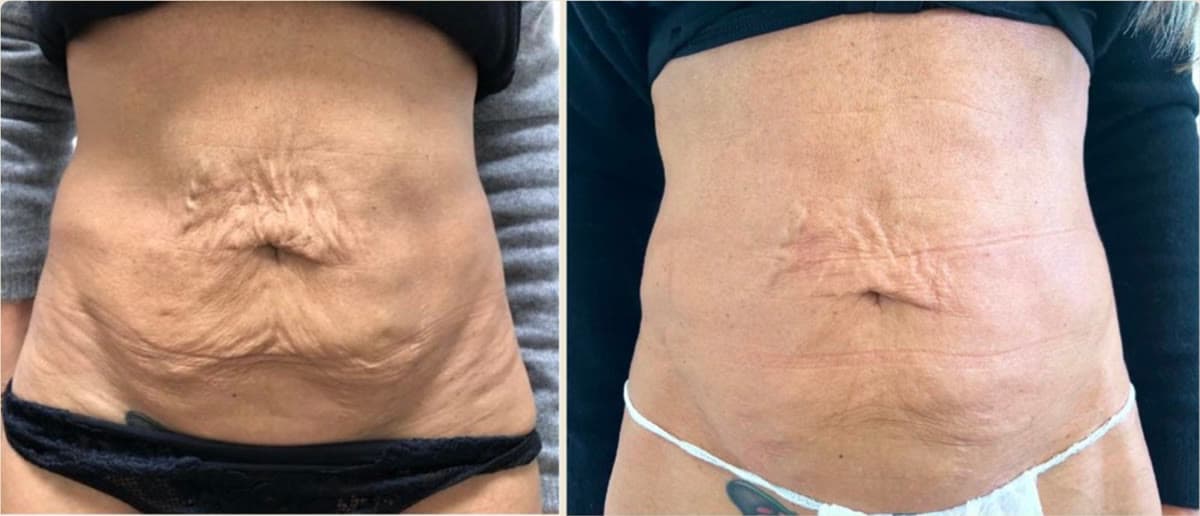
Mild to moderate laxity looks like softness, crepiness, and loss of firmness. The skin is looser than it was, but it still broadly follows the contour of what's underneath. There may also be residual pockets of fat that didn't respond to the weight loss. This category responds to non-surgical treatment.
True skin excess means there is more skin than there is body. It hangs, it folds, it doesn't retract when you change position. This category does not respond meaningfully to non-surgical treatment, and no device — ours or anyone else's — is going to change that. Excess skin is addressed surgically, and that's a conversation for a board-certified plastic surgeon.
Most people fall somewhere on a spectrum between these, and a lot of people are somewhere different in different areas — moderate laxity through the arms, genuine excess through the abdomen. That's normal, and it's the reason a real assessment matters more than a treatment menu.
We'll tell you which category you're in. If what you have is skin excess, we'll say so plainly, and you'll have saved yourself a course of treatments that was never going to get you there.
What ONDA does
ONDA uses microwave energy — the technology is called Coolwaves — delivered at 2.45 GHz. That frequency is selectively absorbed by water-rich tissue, which means it targets subcutaneous fat with more specificity than modalities that heat everything in their path.
In practice, it does two things at once: it reduces stubborn localized fat, and it delivers controlled heat to the dermis, which is the stimulus for collagen remodeling and gradual tightening.
For the post-weight-loss patient, that combination is often the right one, because you're usually not dealing with a pure fat problem or a pure skin problem — you're dealing with a residual pocket that didn't respond to weight loss and skin that's lost its snap around it.
A typical plan is four sessions, one every four weeks. There are no needles, no incisions, and no downtime — temporary redness or warmth in the treated area is common and settles quickly.
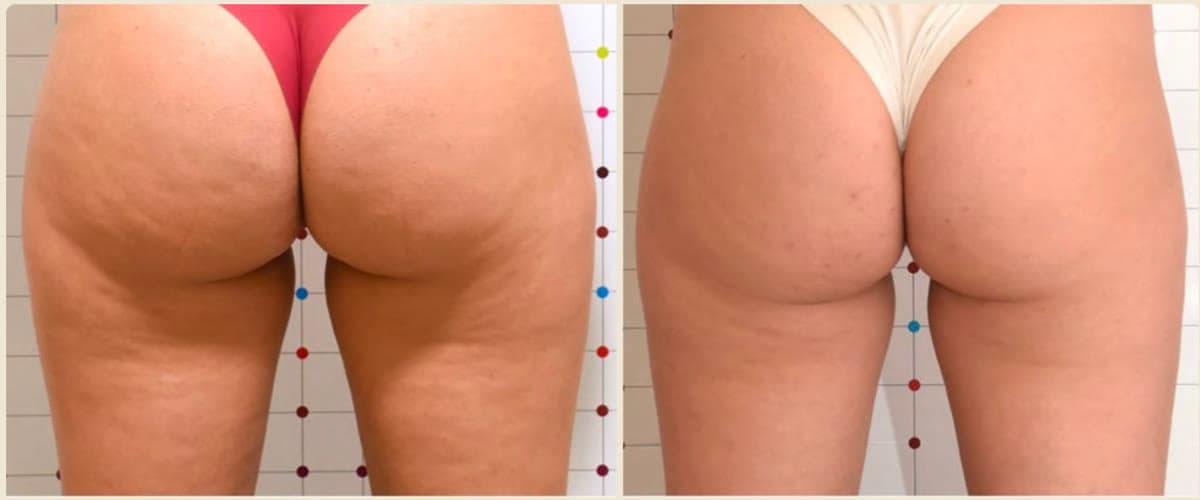
Realistic expectations: results build gradually across the treatment course and for some months after, as collagen remodeling continues. This is not a dramatic before-and-after in two weeks. If someone is promising you that, be careful.
What RF microneedling adds
Radiofrequency microneedling — we use Secret RF — works on a different mechanism and a different depth. Fine needles create controlled micro-injuries in the skin while delivering RF energy directly into the dermis. The combination triggers a wound-healing response that produces new collagen and improves the quality of the skin: texture, tone, firmness.
Pairing the two is one of the more established approaches for post-weight-loss patients right now, and the logic is straightforward. ONDA addresses the larger contour and the deeper laxity. RF microneedling refines the surface. Neither one is doing the other's job well on its own.
Whether you need both, or just one, depends entirely on what your assessment shows. If cost is the deciding factor in how you sequence treatment, financing is available through Cherry and CareCredit — see financing options.
Timing matters more than people expect
We've found that starting ONDA and XTherma during GLP-1 weight loss works better than waiting until there is so much loose skin that surgery is the only option. That's what we've seen in our own patients.
How long you're on a GLP-1 varies a lot from person to person, so there is no single right time to start. We assess you and tell you where you stand.
Consider your maintenance dose. If you're staying on a GLP-1 long-term at a maintenance dose with a stable weight, that's generally a workable situation. Talk to us about it at consultation, and bring your prescriber into the conversation if it's a question.
A note on who this isn't for
ONDA is not appropriate during pregnancy or breastfeeding, or for people with implanted cardiac devices or electronic stimulators, recent malignancy, severe vascular or clotting disorders, or uncontrolled diabetes. Rare potential effects include blistering, bruising, temporary numbness or altered sensation, and contour irregularity.
We review all of this — plus your full medical history — before any treatment. Every ONDA treatment at Neoderma is performed by a licensed medical provider trained and approved by Sal Nadkarni, DO.
What a consultation actually looks like
You come in. We assess the areas that are bothering you, and we're specific about which category each one falls into. If ONDA and RF microneedling can get you a meaningful result, we'll tell you roughly how many sessions and what the realistic outcome looks like — not the best case, the likely case.
And if what you're dealing with is skin excess rather than laxity, we'll tell you that directly, so you can take that information to a board-certified plastic surgeon and have an informed conversation instead of starting from scratch.
We'd rather give you an honest answer you can act on than sell you four sessions of something that was never the right tool.
You worked hard for this. It's worth getting a straight read on what's left.
Post-GLP-1 body contouring FAQ
What is the difference between skin laxity and skin excess?
Mild to moderate laxity looks like softness, crepiness, and loss of firmness — the skin is looser than it was, but it still broadly follows the contour of what is underneath. True skin excess means there is more skin than there is body: it hangs, it folds, and it does not retract when you change position. Laxity responds to non-surgical treatment. Excess does not.
How long should I wait after GLP-1 weight loss before body contouring?
There is no fixed waiting period. How long someone is on a GLP-1 varies a lot, so a set number of months does not fit everyone. What we have found is that starting ONDA and XTherma during the weight loss works better than waiting until there is so much loose skin that surgery is the only option. That is what we have seen in our own patients. We assess you and tell you where you stand.
What does ONDA do for post-weight-loss body changes?
ONDA uses microwave energy — Coolwaves — delivered at 2.45 GHz, a frequency selectively absorbed by water-rich tissue, so it targets subcutaneous fat with more specificity than modalities that heat everything in their path. It does two things at once: it reduces stubborn localized fat, and it delivers controlled heat to the dermis, which is the stimulus for collagen remodeling and gradual tightening. A typical plan is four sessions, one every four weeks.
Can non-surgical treatment fix loose skin after weight loss?
It depends which problem you actually have. Mild to moderate laxity, especially combined with residual fat pockets, often responds well to ONDA plus RF microneedling — results build gradually across the treatment course and for months after as collagen remodels. True skin excess does not respond meaningfully to any device, ours or anyone else's. That is addressed surgically, by a board-certified plastic surgeon.
Who is not a candidate for ONDA body contouring?
ONDA is not appropriate during pregnancy or breastfeeding, or for people with implanted cardiac devices or electronic stimulators, recent malignancy, severe vascular or clotting disorders, or uncontrolled diabetes. Rare potential effects include blistering, bruising, temporary numbness or altered sensation, and contour irregularity. We review all of this, plus your full medical history, before any treatment at Neoderma.
Follow along
Follow us for weekly before-and-afters and specials
Fresh before-and-afters, treatment videos, giveaways, and first look at our monthly specials drop on Instagram and TikTok. Give us a follow so you never miss one.
@ocskinexperts on Instagram · @skinbyneoderma on TikTok
Related Treatments
ONDA Body Contouring →
Coolwaves microwave technology for localized fat, cellulite, and skin laxity — no needles, no downtime.
RF Microneedling (Secret RF & Exceed) →
Radiofrequency energy delivered into the dermis to rebuild collagen and refine skin texture and firmness.
Carboxytherapy →
CO2 microinjections that improve circulation and skin quality — often paired with body contouring plans.