How to Get Rid of Acne Scars: What Works, by Scar Type
There is no single acne scar treatment, because there is no single acne scar. Flat red and brown marks fade with pigment-focused care and SPF. Indented scars are lost collagen and need remodeling — RF microneedling for rolling and boxcar scars, picosecond resurfacing for tone. Match the treatment to the scar, and expect a series.
Medically reviewed by Sal Nadkarni, DO · Last updated July 28, 2026
Is it actually a scar — or a mark?
This is the single most useful thing to learn about your own skin, and it saves a lot of people a lot of money. Most of what people call “acne scarring” in the mirror is not scarring at all. It is discoloration left behind after a breakout has healed, and the skin surface is still perfectly flat.
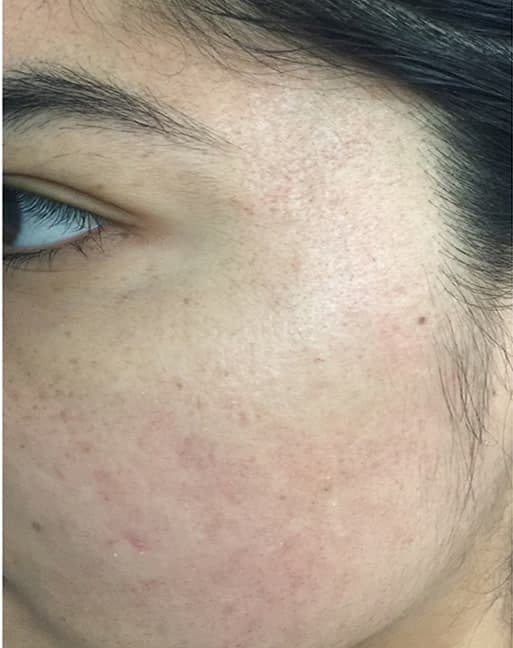
Post-inflammatory erythema (PIE) is the flat red or pink mark that lingers where a pimple used to be. It is not lost tissue — it is residual dilated capillaries from the inflammation. PIE frequently fades on its own over months, and it responds to time, diligent sun protection, and gentle resurfacing rather than to anything aggressive.
Post-inflammatory hyperpigmentation (PIH) is the flat brown or tan version — excess melanin deposited by pigment cells that got stirred up by the inflammation. PIH is more common and tends to last considerably longer in deeper skin tones. It responds to pigment-focused care: picosecond resurfacing, peels, and pigment-regulating skincare, all supported by daily SPF, because UV exposure actively darkens post-acne marks.
True scars are a different problem. Atrophic (indented) scars are a collagen deficit — the healing process simply did not rebuild all the tissue that inflammation destroyed. No amount of brightening serum fills a divot. Those need collagen remodeling. Raised hypertrophic and keloid scars are the opposite problem, too much collagen, and are managed differently again — those always warrant an in-person evaluation before anything is done to them.
How do you identify your scar type?
Here is the self-check we teach in consultations. Stand at a mirror in a room with a single light source off to one side — a window or a lamp, not overhead bathroom lighting. Turn your face slowly. Flat marks disappear as the angle changes, because they have no depth to cast a shadow. Real indented scars do the opposite: they pop into relief as the light rakes across them. That shadow test tells you more in thirty seconds than a straight-on photo ever will.
Once you know you are looking at indentations, the shape tells you which kind. Rolling scars are broad, shallow, wavy depressions with soft sloping edges — they make the cheek look undulating rather than pitted, and they are tethered to tissue underneath. Boxcar scars are wider with sharp, defined vertical walls, like a small crater with a flat floor. Icepick scars are narrow, deep and punctate — as though the skin was pricked with a fine tool. Most people have a mixture of all three, which is exactly why a single treatment rarely addresses everything.
For more on telling rolling, boxcar and icepick scars apart and which treatment is matched to each, see acne scar types at acnecenteroc.com.
Which treatment works for which scar?
| Scar type | What it looks like | Best-matched treatment at Neoderma |
|---|---|---|
| PIE (red marks) | Flat pink or red spots, no texture change | Time and daily SPF first; gentle resurfacing and calming facials |
| PIH (brown marks) | Flat brown or tan spots, no texture change | PicoWay Resolve resurfacing, Vi Peel, pigment-regulating skincare |
| Rolling | Broad, shallow, wavy depressions; tethered underneath | Secret RF microneedling — the strongest match |
| Boxcar | Wider craters with sharp, defined vertical edges | Secret RF microneedling plus resurfacing; deeper ones are stubborn |
| Icepick | Narrow, deep, punctate pits | Hardest type — often needs combination or referral-level technique |
| Mild texture / early scarring | Roughness and faint irregularity rather than true divots | Exceed mechanical microneedling; K-Advanced Bio Glow for barrier and glow |
Secret RF is the workhorse for indented scarring because it delivers radiofrequency energy at a controlled depth through the microneedles, remodeling collagen in the floor of the scar rather than only at the surface. (If you are weighing devices, our Morpheus8 vs. Secret RF comparison covers the differences honestly.) For the color left behind, PicoWay Resolve works photoacoustically with minimal heat, which makes it our first choice for pigment and overall texture. Many plans use both, in sequence.
Why you have to treat active acne first
This is non-negotiable, and it is the step people most want to skip. Treating scars while acne is still breaking out is chasing a moving target: every new inflamed lesion has the potential to leave a fresh mark or a fresh scar, so you spend money remodeling collagen in one spot while new damage forms in another. Active inflammation also makes skin more reactive, which raises the risk of irritation and post-inflammatory pigment after resurfacing.
Getting there is usually straightforward. A medical-grade regimen built from a 3D skin analysis, using ZO Skin Health or SkinBetter Science, does most of the work. The Anti-Acne facial ($225) and Vi Peel Purify ($375), which is formulated for acne-prone skin, help calm things down faster. And when one furious cyst shows up before an event, an emergency pimple shot (a Kenalog cortisone injection, from $100) settles that individual lesion — which is also scar prevention, since the less time a lesion spends inflamed, the less collagen it takes with it.
How many sessions, and how long until you see results?
Acne scar treatment is a series, not a visit. Collagen remodeling is a biological process on a biological timeline: the treatment creates the stimulus, and your body spends the following months laying down and maturing new collagen. Skin often looks smoother and more even within a few weeks, but the change that actually makes scars look shallower typically shows up two to six months after a series. Sessions are spaced several weeks apart to give that healing room to happen.
Preparation matters too. Stop retinoids and exfoliating acids about a week before microneedling, and treat daily SPF as part of the treatment rather than an afterthought — UV darkens post-acne marks and can undo weeks of progress. We photograph your skin at the start so you are comparing against where you actually began, not against your memory of it.
And the honest part: the realistic goal is meaningful improvement — softer, shallower, more even — not perfectly smooth skin. Rolling scars generally reward treatment the most. Boxcar scars improve, with the deepest ones the most stubborn. Icepick scars are the most resistant of all, and we would rather tell you that at the consultation than take your money on a promise the biology will not keep.
What does acne scar treatment cost in Anaheim?
Real numbers, so you can plan. Secret RF microneedling is $1,500 per session, with a package of three normally $4,500 — three sessions is the usual starting point for indented scarring. Exceed microneedling (manufactured by Candela) is $425 per session on its own, a sensible option for milder texture and early scarring. PicoWay Resolve laser resurfacing runs $200–$600 per session depending on the area, and is what we reach for when discoloration is the main complaint.
Supporting care fills in around those: facials run $150–$250 (Balance $150, Anti-Acne $225, DiamondGlow $215), Vi Peels are $375–$425 by tier, and on the Korean skin care menu, Rejuran — a PDRN skin booster applied topically with microneedling here, not injected — starts at $1,055 for 2 mL. Your exact plan depends on your scar mix, which is what a consultation is for.
Financing available through Cherry and CareCredit — split your treatment into flexible monthly payments. Learn more →
Acne scar treatment FAQ
Are red or brown marks from acne actually scars?
Usually not. Flat red or pink marks are post-inflammatory erythema — residual dilated capillaries — and flat brown or tan marks are post-inflammatory hyperpigmentation, which is excess melanin. Neither involves lost collagen, so neither is a true scar. Both often fade on their own over months with daily SPF, and both respond to pigment-focused care rather than to collagen remodeling.
What is the best treatment for indented acne scars?
For rolling and boxcar scars, RF microneedling is the workhorse. Secret RF delivers radiofrequency energy at a controlled depth through microneedles, remodeling collagen in the floor of the scar so the depression softens and shallows over time. At Neoderma it is $1,500 per session, and most indented scarring is treated as a series rather than a single visit.
Can icepick acne scars be fixed?
Icepick scars are the most resistant type. They are narrow, deep and punctate, and because their damage extends well below the surface they often respond least to microneedling alone. Meaningful improvement is realistic; complete correction frequently is not. These scars usually need combination or referral-level in-office techniques, which is something we assess honestly in person.
Do I need to clear my acne before treating my scars?
Yes. Treating scars while acne is still active is working against a moving target, because every new inflamed breakout can create a fresh mark or scar. Active inflammation also raises the risk of irritation from resurfacing. We stabilize the acne first with medical-grade skin care, peels and acne facials, then move into collagen remodeling.
How long until I see results from acne scar treatment?
Texture usually looks a little smoother within a few weeks, but collagen remodeling is gradual. The most meaningful change in indented scars typically shows up two to six months after a series, as new collagen matures. That is why we photograph your skin at the start and compare over months rather than judging the result at your next appointment.
Follow along
Follow us for weekly before-and-afters and specials
Fresh before-and-afters, treatment videos, giveaways, and first look at our monthly specials drop on Instagram and TikTok. Give us a follow so you never miss one.
@ocskinexperts on Instagram · @skinbyneoderma on TikTok
Related Treatments
Microneedling (Secret RF & Exceed) →
Collagen remodeling for rolling and boxcar acne scars — the core of most scar plans.
Laser Skin Resurfacing (PicoWay Resolve) →
Picosecond resurfacing for the brown marks and uneven tone acne leaves behind.
Facials, Peels & LED Therapy →
Anti-Acne facials and Vi Peel Purify to get active breakouts under control first.