Preventative Botox in Your 20s and 30s: Does It Actually Work?
Preventative Botox means starting small doses before deep lines set in— usually in the late 20s or early 30s. It works, but narrowly: it slows the transition from lines you see only when you move to lines that stay at rest. It does not stop aging, and starting later is completely fine.
Medically reviewed by Sal Nadkarni, DO · Last updated July 28, 2026
What is preventative Botox (and “baby Botox”)?
Preventative Botox is not a different product or a different injection — it is the same neuromodulator used earlier and more lightly. Instead of treating lines that are already etched in, you treat the movement that creates them. The American Society of Plastic Surgeons has reported that Botox procedures among people aged 20–29 rose roughly 28% since 2010, and “preventative Botox” has become a major social-media trend with tens of millions of views on TikTok alone. That popularity is real; the claims around it are not always.
Baby Botox is the technique that usually goes with it: smaller, strategically placed doses that soften muscle movement while preserving natural expression. Rather than shutting a muscle down, you dial it back. For a younger face with light lines, that is often all that is needed — and it is why a first appointment here tends to use fewer units than you might expect. If you want the full unit-by-unit breakdown, we wrote a guide to how many units each area takes.
Does starting early actually prevent wrinkles?
It slows line formation. It does not stop aging. Here is the mechanism dermatologists actually cite: every time you squint, frown, or raise your brows, the muscle creases the skin above it. Early on those are dynamic wrinkles— visible only while you are making the expression, gone the moment you relax. Repeat that motion tens of thousands of times over years and the crease stops fully releasing. That is a static wrinkle: visible at rest, in every photo, whether you are expressing or not.
Reducing that repetitive folding slows the dynamic-to-static transition. What it cannot touch is everything else that ages skin: UV damage, collagen and elastin loss, volume change, sleep creases, genetics. Anyone telling you a neuromodulator will keep your face from aging is selling, not explaining. A fair way to think about it is that Botox manages one input out of many — a meaningful one, but only one.
When is the right age to start?
The honest answer is that it depends on your lines, not your birthday. Most dermatologists suggest considering preventative treatment in the late 20s to early 30s, when dynamic lines start leaving faint traces at rest. In the early 20s, with no lingering lines at all, it often has limited value — you would be paying to prevent something that is not yet happening.
Use the mirror test instead. Make your strongest expression — a full squint, a hard frown, brows all the way up. Then relax completely and look again. If the skin goes smooth, you are still firmly in dynamic territory and there is no urgency. If a faint shadow of the line stays behind for a few seconds, that is the window where preventative treatment does its best work.
And to say it plainly: Botox is not right for everyone in their 20s. Some people have deep-set expressions and would genuinely benefit at 26; others will not need anything until their mid-30s or later, and starting later is completely fine. It changes nothing about how well treatment works when you do begin. If you are pregnant, breastfeeding, have certain neuromuscular conditions, or simply are not sure, the right move is a consultation, not a booking. We will tell you if the answer is not yet.
The highest-value prevention at this age is not Botox
If you are in your 20s or 30s and can only commit to one thing, make it sun protection. Daily SPF is the single best preventative step for your skin, full stop — it addresses the largest driver of visible aging, and it costs a fraction of any treatment. Add a well-tolerated retinoid and a consistent, medical-grade routine and you have covered more ground than injectables ever will on their own.
That is why our medical-grade skin care consults start with a 3D skin analysis before anyone talks about units. We build regimens from ZO Skin Health and SkinBetter Science around what your skin is actually doing, and pair them with facials, peels and LED therapy for texture and tone, or RF microneedling when collagen is the real issue. Botox is a complement to that foundation, not a substitute for it.
Will it make me look frozen?
No — and if it does, that is a dosing problem, not a Botox problem. The frozen look comes from too much product placed in the wrong muscles, usually by someone treating every face the same way. Baby Botox does the opposite: light doses, mapped to how your face moves, so movement is softened rather than erased. You should still be able to smile, frown, and lift your brows.
Practically, that means we start conservative. Results generally show in 3–5 days, peak around two weeks, and last about 3–4 months (Daxxify can last longer, up to about six months). If at your two-week point you want a little more softening, adding units is easy; taking them away is not. With injecting experience since 2002 and treatments performed by licensed and certified medical providers, that under-treat-then-adjust approach is how we keep first-timers looking like themselves.
Does your face age faster if you stop?
This is the fear that keeps most people from trying it, and it is not what happens. Botox temporarily reduces muscle contraction. When you stop, the effect wears off over roughly three to four months and the muscles simply regain their normal movement. You do not snap back worse; you return to the aging trajectory you were always on.
What confuses people is the contrast. After a year or two of softened lines, seeing your baseline again feels like a sudden change — but it is your normal face, not accelerated aging. There is no dependency, no withdrawal, and no penalty for stopping whenever you want. That is worth knowing before you start, because a treatment you can walk away from is a much easier decision than one you cannot.
What does it cost for a first-timer?
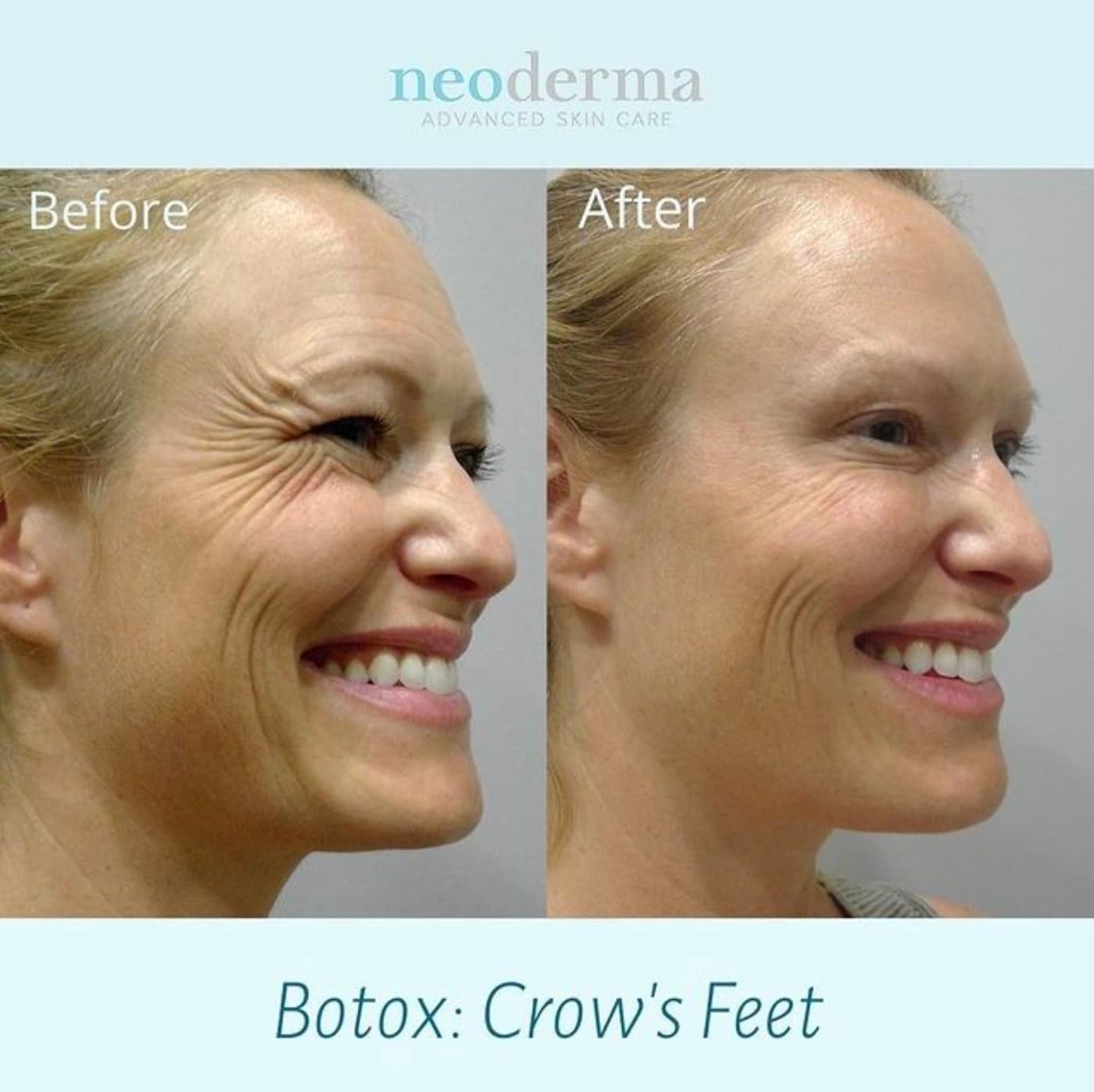
Botox at Neoderma is $12.95 per unit, so you pay for exactly what you use — which is the whole point of a lighter preventative dose. Frown lines (the 11s between your brows) typically take about 15–20 units, or roughly $194–$259. The forehead runs about 8–16 units. Crow's feet take about 6–12 units per side region. A lip flip is a flat $150. We also offer Dysport at $4.25 per unit and Daxxify at $6.50 per unit — different products dose differently, so compare the treatment plan, not the sticker price per unit.
First-time Botox patients get $65 off by signing up with Allē, Allergan's rewards program — we will walk you through it at your visit. If volume rather than movement turns out to be your concern, dermal fillers are a separate conversation, and you can browse everything by what is actually bothering you instead of by product.
Financing available through Cherry and CareCredit — split your treatment into flexible monthly payments. Learn more →
Preventative Botox FAQ
Does preventative Botox actually work?
Partly. Botox does not stop aging, but it does interrupt one specific mechanism: repeated muscle contraction folds the skin over and over, and across years those dynamic lines you see only when you move become static lines visible at rest. Softening that repetitive folding slows the transition. It does nothing about sun damage, collagen loss, or volume change.
What age should you start preventative Botox?
There is no magic birthday. Most dermatologists suggest considering it in the late 20s to early 30s, when dynamic lines begin leaving faint traces at rest. In the early 20s with no lingering lines, it often has limited value. Try the mirror test: make your strongest expression, relax completely, and see whether a faint line stays behind.
How much does preventative Botox cost in Anaheim?
Botox is $12.95 per unit at Neoderma, so you only pay for what you actually use. Frown lines typically take about 15 to 20 units, the forehead about 8 to 16 units, and crow's feet about 6 to 12 units per side region. A lip flip is a flat $150. First-time patients get $65 off by signing up with Allē.
Will preventative Botox make me look frozen?
Not when it is dosed well. A frozen look comes from too much product placed in the wrong muscles, not from Botox itself. Baby Botox uses smaller, strategically placed doses that soften movement while preserving natural expression. You should still smile, frown, and raise your brows. We start conservative and can add more at your two-week check-in.
Does your face age faster if you stop getting Botox?
No. This is the most common fear online and it is not what happens. Botox temporarily reduces muscle contraction, and when you stop, those muscles simply regain their normal movement over about three to four months. You return to the aging trajectory you were always on — you do not end up worse than if you had never started.
Follow along
Follow us for weekly before-and-afters and specials
Fresh before-and-afters, treatment videos, giveaways, and first look at our monthly specials drop on Instagram and TikTok. Give us a follow so you never miss one.
@ocskinexperts on Instagram · @skinbyneoderma on TikTok
Related Treatments
Botox, Dysport & Daxxify →
Neuromodulators from $12.95/unit — baby Botox, frown lines, crow's feet and lip flips.
Medical-Grade Skin Care →
3D skin analysis plus ZO and SkinBetter regimens — the highest-value prevention in your 20s and 30s.
Facials, Peels & LED Therapy →
Texture, tone and glow treatments that pair naturally with a light injectable plan.