Ozempic Hair Loss: What the July 2026 BMJ Study Found, and When Anaheim Patients Should Treat It
Hair shedding on Ozempic, Wegovy, Zepbound or Mounjaro is real, more common in women, and usually temporary. It is telogen effluvium triggered by rapid weight loss, not the drug damaging your follicles. It typically starts 1.5 to 3 months in and eases 3 to 6 months after your weight stabilizes. At Neoderma in Anaheim, we treat the cases that don't.
Medically reviewed by Sal Nadkarni, DO · Last updated September 4, 2026
Does Ozempic actually cause hair loss?
Yes, at the population level, and 2026 is the year the evidence firmed up. A BMJ cohort published July 22, 2026 followed nearly 40,000 adults with type 2 diabetes and found that people on a GLP-1 receptor agonist had a 37% higher risk of alopecia than people on an SGLT-2 inhibitor, and a 68% higher risk than people on a DPP-4 inhibitor. The hair loss was predominantly non-scarring, which is the kind that recovers.
The absolute numbers matter as much as the percentages. In the BMJ cohort, that meant 6.91 cases per 1,000 person-years on a GLP-1 versus 5.04 on an SGLT-2 inhibitor, and 6.53 versus 3.89 against DPP-4 inhibitors. Rare either way, in other words, but reliably more common. The authors also noted their records could not tell them how severe the hair loss was, how long it lasted, or whether it grew back once the medication stopped.
A Science Progress systematic review published April 17, 2026 pooled 24 studies and reached the same conclusion from the trial side: alopecia at 6.0 per 1,000 patient-years on GLP-1 medications versus 0.8 on placebo, roughly a three-fold increase. In the tirzepatide trials (Zepbound, Mounjaro), 5.4% of treated participants reported hair loss against 0.9% on placebo; in a high-dose oral semaglutide trial it was 7% versus 3%. Cleveland Clinic's working estimate is that somewhere between a quarter and a third of people using these drugs for weight loss notice some shedding. It is real. It is also, for most people, not permanent.
Why does rapid weight loss make hair fall out?
Because your follicles read a fast calorie deficit as a stress event and respond the way they do to surgery, high fever, or childbirth: a large share of them drop out of the growth phase and into the resting phase at once. That is telogen effluvium. Roughly two to three months later, those resting hairs release together, and the shower drain suddenly looks alarming. The medication itself is not poisoning follicles; the speed of the weight loss is the trigger, and any crash diet can do the same.
The timeline is consistent across sources. The Science Progress review puts the expected onset at 1.5 to 3 months after starting treatment or increasing the dose, which is why a shed so often starts after a titration step rather than after the first injection. Doris Day, MD, a dermatologist interviewed by Healio on July 29, 2026, described a shed that often occurs for three to four months after the rapid weight loss. The review also describes the shedding as typically reversible, with improvement generally seen within 3 to 6 months of weight stabilizing. Visible density lags behind that by several more months, because regrowth is slow.
One thing worth being clear about: the same fast fat loss that empties the fat pads under your cheeks, the change people call Ozempic face, is the driver here too. Hair and facial volume are two symptoms of one cause, and both respond to the weight loss slowing down.
Why are women affected more than men?
The data on this is stark. In the tirzepatide trial figures cited by the Science Progress review, hair loss was reported by 7.1% of women versus 0.5% of men, and in one cohort the adjusted hazard ratio for hair loss was significant only in females, at 2.08. The review's own phrase is that females appear to be disproportionately affected.
Nobody has proven why, but the plausible reasons stack up. Women are more likely to start a GLP-1 with lower iron stores. Female-pattern thinning is diffuse, showing up as a widening part rather than a receding hairline, so a diffuse shed on top of it is noticed sooner and reported more often. We wrote about how women's thinning differs from men's in our post on why thinning hair isn't just a men's problem; the short version is that the pattern underneath decides whether a GLP-1 shed fully recovers.
Is it temporary shedding, or pattern thinning that was already there?
This is the question that decides everything else, and it is usually answerable from history alone. Telogen effluvium is a diffuse, all-over shed with a clear start date and a clear trigger. Pattern thinning is slower, sits in a predictable territory, and almost always predates the medication if you look at old photos honestly. Many people have both: a pre-existing widening part that the GLP-1 shed unmasked.
| Temporary GLP-1 shedding (telogen effluvium) | Pattern thinning (female- or male-pattern) | |
|---|---|---|
| Onset | Sudden, 1.5–3 months after starting or a dose increase; you can usually name the month | Gradual over years; often visible in photos from before the medication |
| Pattern | Diffuse, across the whole scalp; hairline stays put | Widening part and thinning crown in women; receding temples and crown in men |
| Pillow and brush | Handfuls; full-length hairs with a small white bulb on the end | Normal daily count, but regrowth comes in finer and shorter each cycle |
| Course | Self-limiting; typically eases 3–6 months after weight stabilizes, density returns over the following months | Progressive without treatment; follicles miniaturize and eventually stop producing |
| What helps | Time, adequate protein, correcting iron or vitamin D deficiency with your physician, a gentler titration | Active treatment while follicles are still alive: our 12-week non-surgical hair restoration protocol, medical options via a dermatologist |
Is it the drug, or is it just fall?
Sometimes it is both, and the calendar deserves a mention before you blame your prescription for all of it. Human hair shedding is seasonal and peaks in late summer and fall: a 2008 study of 823 women by Kunz and colleagues found the share of resting-phase hairs highest in July and lowest in February, and a 1999 study of 2,857 patients by Piérard-Franchimont and Piérard found it elevated from July through October. Because resting hairs fall two to three months after they enter that phase, a July peak becomes an October drain.
If you started a GLP-1 this spring or summer, the two curves can stack in exactly the months you are reading this. A September or October shed is not, on its own, evidence that anything has gone wrong.
What should you do first?
Three things, none of which involve us, and none of which involve stopping the medication on your own. First, protein: a strong appetite suppressant makes it easy to under-eat it for months, and hair is built from it. Second, ask your prescribing physician to check ferritin (iron stores), vitamin D, and thyroid function, because a deficiency that was borderline before the weight loss can lengthen the shed and blunt the recovery. Third, if the shed started right after a dose increase, ask whether a slower titration makes sense for you. Those decisions belong with the doctor who prescribes the drug. We advise on hair and skin, never on your prescription.
When is it worth starting treatment instead of waiting it out?
Here is the rule we actually use, because “talk to your doctor” is not a plan. Wait if the shed is diffuse, started inside the expected window, and your weight is still dropping; the odds are with you. Book a consultation if any one of these is true:
- The shedding has not slowed 4 to 6 months after your weight stabilized. That is past the reversal window the evidence describes, and it usually means something other than telogen effluvium is at work.
- Your part was already widening before the medication. The GLP-1 unmasked pattern thinning that tends to keep progressing on its own, and the sooner active follicles get support, the more there is to work with.
- You have a family history of pattern hair loss on either side, or the regrowth is coming in noticeably finer than the hair you lost.
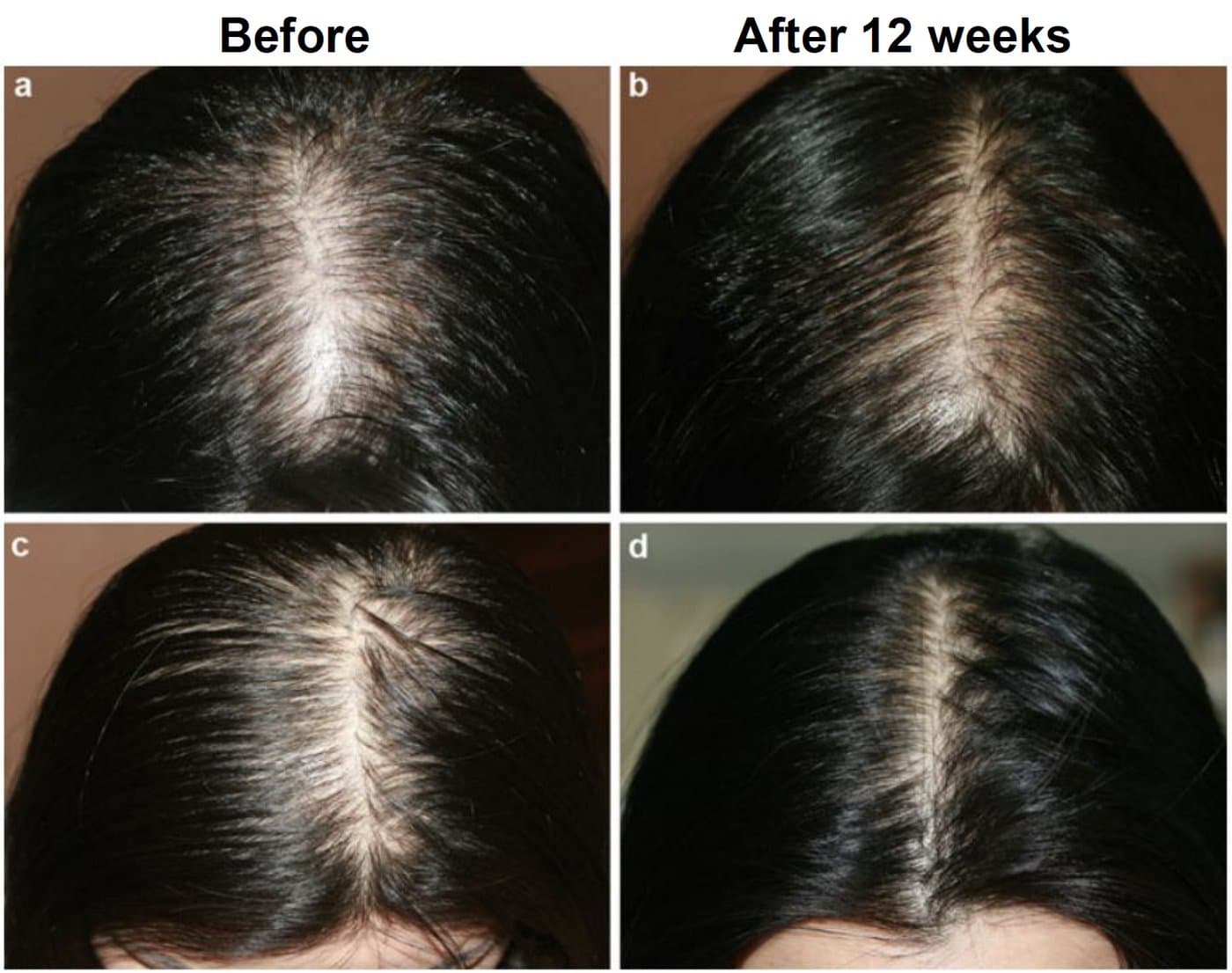
What we offer is non-surgical hair restoration: a scalp protocol that delivers clinically studied growth factors to follicles that are still alive, one session per week for 12 weeks, about 30 minutes each, with essentially no downtime. It has been evaluated in published studies of both men and women; in the men's study, hair count and thickness each increased by roughly 11% over 12 weeks, and in the women's study the gains were maintained in the group followed for 6 to 12 months afterward. It supports follicles that are miniaturizing; it does not revive areas that are fully bald, and it does not stop a telogen effluvium that is still running its course. If your consultation says wait, we will say wait.
Because it is a weekly series, the protocol is priced as a 12-week package matched to your scalp and goals, quoted at your consultation. We have been treating patients from Anaheim and across Orange County since 2001, and the hair protocol is exclusive to Neoderma in the county.
Financing available through Cherry and CareCredit — split your treatment into flexible monthly payments. Learn more →
Ozempic hair loss FAQ
Will my hair grow back after Ozempic?
For most people, yes. Shedding on a GLP-1 is almost always telogen effluvium, a temporary shift of follicles into their resting phase triggered by rapid weight loss. The follicles are not destroyed. The April 2026 Science Progress systematic review describes it as typically reversible, with improvement generally seen within 3 to 6 months of your weight stabilizing. Hair that does not recover on that timeline usually points to pattern thinning that was already underneath.
How long does Ozempic hair loss last?
Shedding typically starts 1.5 to 3 months after you begin the medication or increase your dose, and eases 3 to 6 months after your weight levels off. Because hair grows slowly, the density you see in the mirror lags the shedding by several more months. If the shedding has not slowed 4 to 6 months after your weight stabilized, it is worth having the scalp evaluated rather than waiting longer.
Should I stop Ozempic if my hair is falling out?
Not on your own. The shedding is driven by the speed of weight loss, not by the drug poisoning your follicles, and stopping abruptly can undo the health gains you took the medication for. Talk to your prescribing physician, who may slow the titration or check for a contributing deficiency. Our role at Neoderma is the hair and scalp; we never advise on your prescription.
Does Zepbound or Mounjaro cause hair loss too?
Yes, and by the trial numbers, at a similar or higher rate. Zepbound and Mounjaro are tirzepatide; in the tirzepatide trials summarized in the April 2026 Science Progress review, alopecia was reported in 5.4% of treated participants versus 0.9% on placebo, with women affected far more often than men. The mechanism is the same as with semaglutide: fast weight loss pushing follicles into their resting phase.
What is telogen effluvium?
Telogen effluvium is a temporary shedding condition. Normally a small share of your follicles are resting at any moment; a shock to the body such as rapid weight loss, illness, surgery, or childbirth shifts a much larger share into the resting phase at once. About two to three months later those hairs fall out together, which is why the shedding seems sudden. Once the trigger settles, the follicles cycle back into growth.
Is my fall hair shedding from the drug or the season?
Possibly both. Human hair shedding is biologically highest from July through October: a 2008 study of 823 women found resting-phase hair peaked in July, and a 1999 study of 2,857 patients found it elevated July through October. If you started a GLP-1 in spring or summer, the seasonal peak and the drug-related shedding can land in the same months. We would rather you know that than blame the whole thing on your prescription.
When should I get hair treatment instead of waiting?
Our rule of thumb: if shedding has not slowed 4 to 6 months after your weight stabilized, if your part was already widening before you started the medication, or if you have a family history of pattern thinning, it is worth a consultation. Neoderma's non-surgical hair restoration is one session per week for 12 weeks, priced as a package and quoted at your consultation, with financing through Cherry and CareCredit. If it is still simple telogen effluvium inside its window, we will tell you to wait.
Follow along
Follow us for weekly before-and-afters and specials
Fresh before-and-afters, treatment videos, giveaways, and first look at our monthly specials drop on Instagram and TikTok. Give us a follow so you never miss one.
@ocskinexperts on Instagram · @skinbyneoderma on TikTok
Related Treatments
Non-Surgical Hair Restoration →
Clinically studied growth factors delivered to the scalp, one session a week for 12 weeks — for thinning that outlasts the GLP-1 shedding window.
XTherma Skin Tightening →
High-frequency RF for the face, neck and body laxity that fast weight loss leaves behind. $950 per session, full face (fall special, reg. $1,500 per session).
ONDA Body Contouring →
Coolwaves microwave technology for the stubborn fat pockets and cellulite the weight loss never touched.