How to Get Rid of Stretch Marks: What Actually Works
You can't erase stretch marks completely — no cream or device can honestly promise that. What you can do is fade, flatten, and blend them with collagen-remodeling treatments. At our Anaheim clinic that means carboxytherapy (from $195 per session) or Secret RF microneedling, matched to whether your marks are still red or already white.
Medically reviewed by Sal Nadkarni, DO · Last updated August 21, 2026
What are stretch marks, and why don't they fade on their own?
Stretch marks (striae) are tears in the dermis — the skin's structural middle layer — left behind when skin stretches faster than its collagen can adapt: pregnancy, growth spurts, rapid weight change, fast muscle gain. The surface heals over, but the torn collagen underneath doesn't rebuild itself, which is why the marks linger for decades.
Color tells you their age. New marks are red or purple (striae rubrae) — still vascular, still biologically active, and the most responsive to treatment. Mature marks are white or silver (striae albae) — settled scars that only improve when you rebuild collagen inside them. The color and age of your marks, more than anything else, drive the right plan.
Do stretch mark creams actually work?
Mostly, no. Over-the-counter creams cannot rebuild torn dermal collagen, no matter the price tag. Prescription retinoids can modestly improve early, still-red stretch marks. Cocoa butter and oils feel nice and hydrate the surface, but they have no evidence of removing stretch marks — the tear sits far deeper than any cream reaches.
That's worth saying plainly because the stretch mark aisle is built on hope. If your marks are brand new and red, ask your doctor about a prescription retinoid — that's the one topical window with real (if modest) evidence behind it. If your marks have already turned white, save the money: from that point forward, improvement comes from remodeling collagen in-office, not from anything in a jar.
How does carboxytherapy fade stretch marks?
Carboxytherapy injects a small amount of medical-grade CO2 just beneath the mark with a very fine needle. Your body reads the gas as a signal to flood the area with oxygen-rich blood, which kicks collagen production into gear. It starts at $195 per session for small areas, with larger body areas typically $200–$400.
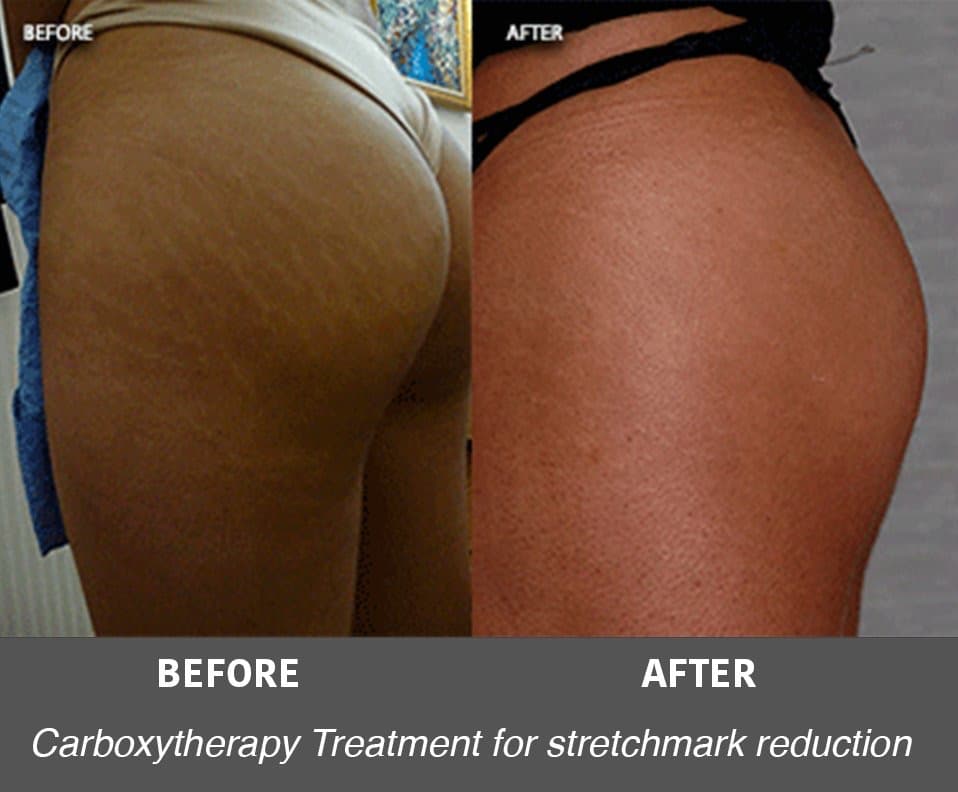
Most stretch mark plans run 4–6 sessions spaced about a month apart, with no downtime — you can return to your day immediately — and it's safe for all skin types. The photo at the top of this post is a real Neoderma client's carboxytherapy result, not a stock image: the marks are visibly faded and smoothed, which is exactly the honest outcome to expect.
Is RF microneedling good for stretch marks?
Yes — it's one of the strongest collagen-remodeling tools we have for mature, white marks. Secret RF microneedling delivers radiofrequency energy through 64 gold-plated microneedles, stimulating collagen and elastin at the depth where the tear actually lives. It's $1,500 per session — and ask about current series pricing, since 3-session packages are often discounted.
Because the energy goes in below the surface through insulated needles, Secret RF is safe across skin tones, and stretch mark series are planned per area — usually about three sessions spaced 4 weeks apart. Downtime is brief: redness for the first few hours, fully settled within about a week. It's the same remodeling process we use on pitted acne scars — our guide to getting rid of acne scars covers that side of the story.
Carboxytherapy vs. Secret RF vs. creams: how do they compare?
Think of it this way: creams hydrate the surface, carboxytherapy boosts circulation and collagen with no downtime, and Secret RF remodels the dermis most aggressively. Red, newer marks respond to either in-office option; mature white marks usually point toward Secret RF or a combination. Your consultation matches the tool — or the stack — to your marks.
| Carboxytherapy | Secret RF | Creams & oils | |
|---|---|---|---|
| How it works | Medical-grade CO2 injections boost circulation & collagen | Radiofrequency via 64 gold-plated microneedles | Surface hydration only |
| Best for | Red or white marks; no-downtime plans | Mature white marks; texture & laxity | Early red marks (prescription retinoids only) |
| Typical plan | 4–6 sessions, ~1 month apart | Series per area, ~4 weeks apart | Daily, indefinitely |
| Downtime | None | Redness a few hours; ~1 week to fully settle | None |
| Cost | From $195/session; $200–$400 for body areas | $1,500/session; ask about current series pricing | Varies — none rebuild collagen |
Financing available through Cherry and CareCredit — split your treatment into flexible monthly payments. Learn more →
Why are GLP-1 medications causing so many stretch mark questions?
Rapid weight change is one of the classic triggers for stretch marks, and GLP-1 medications have made rapid weight loss common. Losing weight quickly often reveals marks that formed as weight went on — and adds loose, deflated skin on top, so many clients finish their weight-loss journey with both stretch marks and laxity to address.
The good news: the same collagen-rebuilding treatments help both problems, and they can be sequenced in one plan. If that's your situation, our guide to body contouring after GLP-1 weight loss walks through the loose-skin side in detail — stretch marks are usually one piece of that bigger picture.
Honest expectations: faded and blended, not erased
No treatment — ours included — removes stretch marks 100%. What a well-planned series does is fade the color, flatten the raised or sunken texture, and blend the marks into surrounding skin until they stop catching your eye. For most people, that's the outcome that actually matters.
Two honest rules of thumb from 25 years of treating skin in Anaheim and across Orange County: earlier is easier — red marks respond faster than white ones, so don't wait years to ask — and anyone promising complete removal is selling you something. At your consultation we'll tell you which of your marks will improve most, how many sessions to realistically expect, and when we'd honestly recommend spending nothing at all.
Stretch mark treatment FAQ
Can you get rid of stretch marks completely?
No — and you should be skeptical of anyone who promises that. No cream, laser, or device erases stretch marks 100%. What in-office treatments like carboxytherapy and RF microneedling genuinely do is fade the color, flatten the texture, and blend the marks into the surrounding skin so they're dramatically less noticeable.
Do creams like cocoa butter work on stretch marks?
Over-the-counter creams and oils can't rebuild torn dermal collagen, and cocoa butter has no evidence of removing stretch marks. Prescription retinoids can modestly improve early, still-red marks. Once stretch marks have matured to white, meaningful improvement requires collagen-remodeling treatment rather than topicals.
How much does stretch mark treatment cost in Anaheim?
At Neoderma, carboxytherapy starts at $195 per session for small areas, with larger body areas typically $200–$400 per session. Secret RF microneedling is $1,500 per session — and ask about current series pricing, since 3-session packages are often discounted. You'll get an exact quote at your consultation, and financing is available through Cherry and CareCredit.
How many sessions does it take to fade stretch marks?
Carboxytherapy typically takes 4–6 sessions spaced about a month apart, with improvement building each visit. Secret RF microneedling is planned per area, usually as a series of three treatments spaced about 4 weeks apart. New, red stretch marks generally respond faster than mature white ones.
Are red or white stretch marks easier to treat?
Red or purple stretch marks are newer, still have an active blood supply, and respond best to treatment — that's the ideal window. White or silver marks are mature scars that need collagen remodeling to improve, which usually means more sessions. Both improve; earlier is simply easier.
Why did I get stretch marks after losing weight?
Rapid weight change in either direction can outpace your skin's collagen. Fast weight loss — increasingly common with GLP-1 medications — often reveals stretch marks that formed earlier and adds loose, crepey skin on top. Collagen-rebuilding treatments can address both, and a consultation will map the right combination for you.
Follow along
Follow us for weekly before-and-afters and specials
Fresh before-and-afters, treatment videos, giveaways, and first look at our monthly specials drop on Instagram and TikTok. Give us a follow so you never miss one.
@ocskinexperts on Instagram · @skinbyneoderma on TikTok
Related Treatments
Carboxytherapy →
CO2 injections for stretch marks, dark circles, and crepey skin — from $195 per session, no downtime.
Microneedling (Secret RF & Exceed) →
Radiofrequency through 64 gold-plated needles for stretch marks, scars, and skin tightening.
How to Get Rid of Acne Scars →
Same collagen-remodeling science, different scars — our honest guide to treating acne scarring.